Rejuvenation Peptide comparison: GHK-Cu vs GLOW
The difference starts with the contents. The more revealing comparison is which outcome each research record can address.
Contents and clinical record
GLOW already contains GHK-Cu. Comparing them means comparing a defined copper complex with a non-standardised mixture that adds BPC-157 and TB-500. The review of unapproved injury and performance peptides discusses the constituents; no controlled trial has tested GLOW against GHK-Cu alone, or tested the blend as a unit.
| Question | GHK-Cu | GLOW |
|---|---|---|
| Contents | GHK bound to copper | GHK-Cu, BPC-157, TB-500 |
| Definition | A defined copper complex | Ratios vary by formulation |
| Human skin record | Small topical studies | No controlled blend trial |
| Whole-body rejuvenation | Unestablished | Unestablished |
| Combination safety | Depends on the preparation | Uncharacterised for the blend |
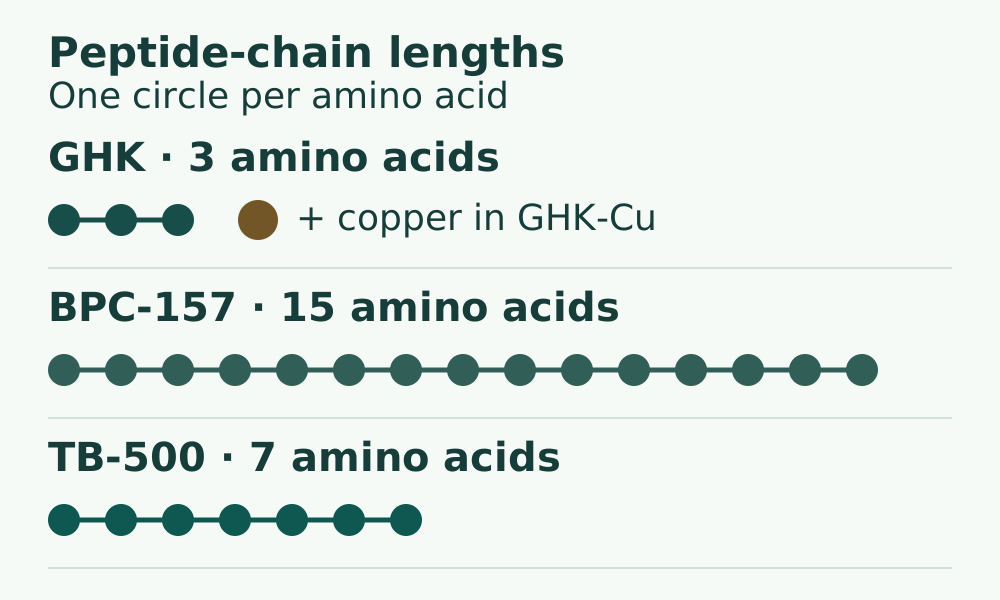
GHK has three amino acids, BPC-157 has fifteen and TB-500 has seven. The last is a fragment of thymosin beta-4; much of the parent protein’s literature therefore addresses a different substance. I regard that identity gap as one of the consequential differences behind the simple phrase “GHK-Cu vs GLOW”.
For younger-looking skin
GHK-Cu has the more direct human topical record. The 2025 anti-wrinkle review discusses facial studies and delivery limitations; the 2015 skin review describes changes in laxity, clarity, fine lines and wrinkle measures. Those findings address appearance and properties of skin under the tested conditions.
GLOW draws on those findings for its own skin rationale, but its formulation and commonly reported systemic route differ. I’d reserve judgement on a claimed advantage until the mixture has been compared with its parts using a defined preparation and the same skin outcomes.
For injury recovery
The recovery argument leans on BPC-157 and the thymosin beta-4 family. The BPC-157 musculoskeletal review found only three small human pilots. The VEGFR2 study used chick and rat models plus human endothelial cells in culture to investigate blood-vessel growth. These experiments make the research interesting while leaving human GLOW recovery claims untested.
Injury recovery has a starting condition and a function to restore. A cosmetic study may instead measure how skin looks or feels. Neither result by itself demonstrates slower ageing. For me, defining the ambition comes before declaring a winner.
Safety of systemic exposure
For GHK-Cu, a study of excised human skin measured copper penetration and dermal retention. Delivery of a topical preparation and exposure after injection are separate experimental questions. Human systemic GHK-Cu pharmacokinetics remain unvalidated; GLOW adds unknown combination stability, clearance and interactions.
The 2026 safety review describes scarce rigorous human safety data for the unapproved constituents and potential for serious harm. Angiogenesis raises a theoretical concern in active or recent cancer, while copper dysregulation raises a separate concern for GHK-Cu. The blend has no controlled safety study.
Topical Copper Tripeptide-1 is a legal cosmetic ingredient; GHK-Cu has no approved therapeutic indication, and GLOW is not FDA-approved. BPC-157 and TB-500 make GLOW prohibited in tested sport at all times. GHK-Cu was not named on the 2024–2025 WADA lists described in this research record, but S0 can apply to non-approved pharmacological substances. The GHK-Cu and GLOW pages unpack the respective findings and cautions.